stars
A star is a giant glowing ball of hot gas that makes its own light and heat by squeezing atoms together deep in its core.
What a star really is
Look up on a clear night and you'll see thousands of tiny lights. Each one is actually a colossal sphere of gas—mostly hydrogen and helium—burning so brightly that its glow crosses unimaginable distances to reach your eye. Our own Sun is a star too, just a very close one. It only looks bigger and warmer because the others are so far away.

The Sun, our nearest star, seen in ultraviolet light — source
The engine inside
Stars shine because of their crushing gravity. A star's own weight squeezes its center until the temperature soars to millions of degrees. There, hydrogen atoms are forced to merge into helium, a process called nuclear fusion—like nature's most powerful furnace. Each merge releases a burst of energy, and trillions happening every second are what make a star pour out light and heat for billions of years.
Why stars have colors
Stars aren't all white. Their color reveals their temperature, a bit like heating metal on a stove. Cooler stars glow red, medium ones (like our Sun) look yellow, and the hottest blaze blue-white. The bright red giant Betelgeuse in the constellation Orion is cool but enormous, while blue stars are scorching furnaces.
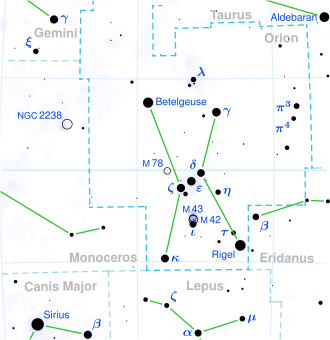
Betelgeuse, a red supergiant star in the constellation Orion — source
Birth and death
Stars are born inside vast clouds of gas and dust called nebulae, where gravity pulls material together until fusion ignites. They live for millions or billions of years. When a small or medium star finally runs out of fuel, it swells, then gently fades. But a giant star dies in a titanic explosion called a supernova, briefly outshining an entire galaxy and scattering the ingredients for new stars—and even planets like Earth.
The carbon in your body and the iron in your blood were forged inside ancient stars. As astronomer Carl Sagan famously said, "We are made of star-stuff."
Further exploration
- Carl Sagan, Cosmos (1980) — a warm, wonder-filled tour of stars and the universe.
- Pillars of Creation (Hubble image, 1995) — a breathtaking photograph of star birth inside the Eagle Nebula.